Track Mower & Skid Steer Loader Manufacturer

Contact Us
Track Mower & Skid Steer Loader Manufacturer
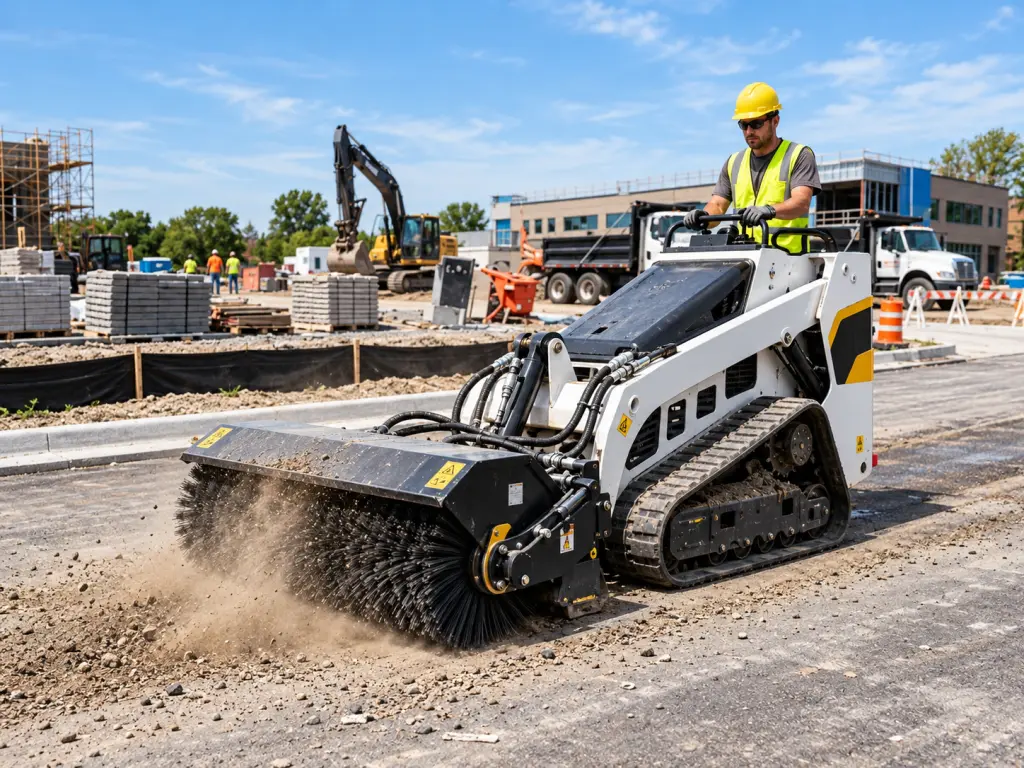
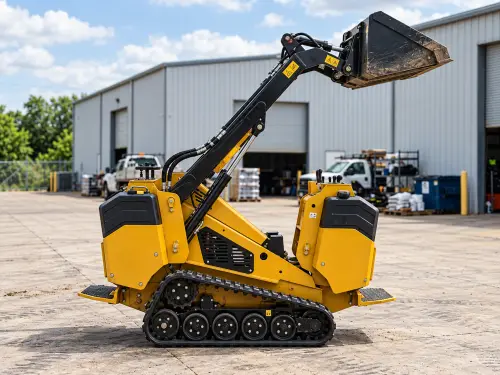
Pick a sweeper attachment by matching three things to your mini skid steer, not just the job: brush width within your carrier’s rated lift and flow capacity, bristle type suited to the debris you move (poly for dirt and debris, wire for scraping and ice), and a mount that fits your quick-attach plate. Get any one of those wrong and you either stall the hydraulics or overload the loader arms. Most sweeper listings are written for full-size skid steers, so the specs you see online are frequently the wrong starting point for a mini carrier.
Key takeaways
A wider brush spins slower unless it gets more hydraulic flow to drive it. That’s the part most buyers skip past, and it’s why a sweeper that looked fine on paper ends up dragging across the lot instead of sweeping it clean.
Mini skid steers run lower GPM than full-size machines. A 68 to 84 inch sweeper built for a standard skid steer, the kind you’ll see listed at rental counters with 860-plus pound weight ratings, will likely stall or underperform when forced onto a mini carrier’s auxiliary circuit. The motor inside the brush housing needs a minimum flow range just to reach effective sweeping RPM, and if your machine can’t supply it, you get a brush that spins weakly and leaves debris behind.
Weight matters just as much as flow. A mini skid steer’s rated lift capacity caps how heavy a sweeper housing it can carry without tipping forward, especially with the arms extended or on a slope. Add a full hopper of wet leaves to a pick-up broom and that weight shifts further forward, which changes the stability math again.
Check the attachment’s rated flow range against your machine’s spec sheet before you even look at width. Flow is the harder limit. Width just determines how much ground you cover per pass, but flow determines whether the brush spins fast enough to do anything useful at all. If you’re still comparing carriers, our guide on how long skid steer tracks last covers related wear factors that affect total cost of ownership alongside attachment compatibility.
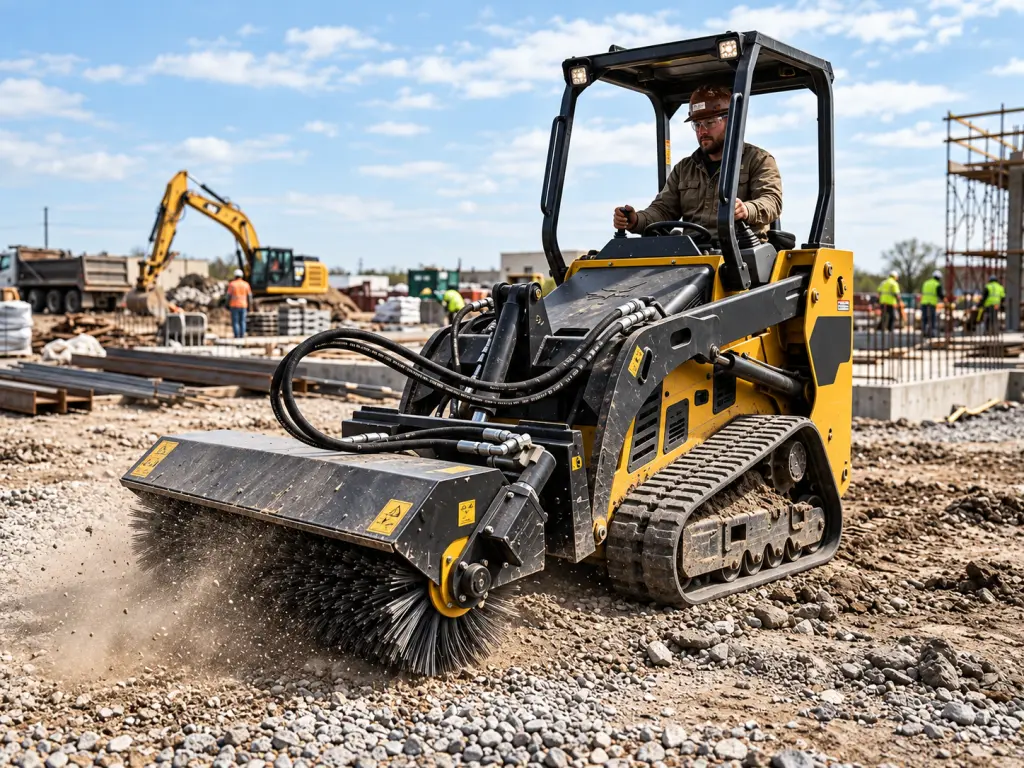
Three broom types cover almost every mini skid steer sweeping job, and picking the wrong one means extra passes or debris you still have to haul away by hand.
The angle broom pushes loose debris to one side as the machine moves forward. It’s the workhorse for construction site cleanup and clearing walkways or parking lots where you just need material out of the way, not collected.
The pick-up broom collects debris into an attached hopper instead of pushing it aside. That matters anywhere debris needs to be hauled off site rather than just relocated, which is the usual case in property management and municipal-style cleanup work.
The gutter brush is narrower and stiffer, built for edge work along curbs, drainage channels, or tight landscaping borders where a full-width broom can’t reach cleanly.
Mapped against the jobs most mini skid steer owners actually do: angle brooms for construction site prep, pick-up brooms for property management debris removal, and gutter brushes for landscaping edge work in parks and gardens. See the comparison table above for a side-by-side breakdown.
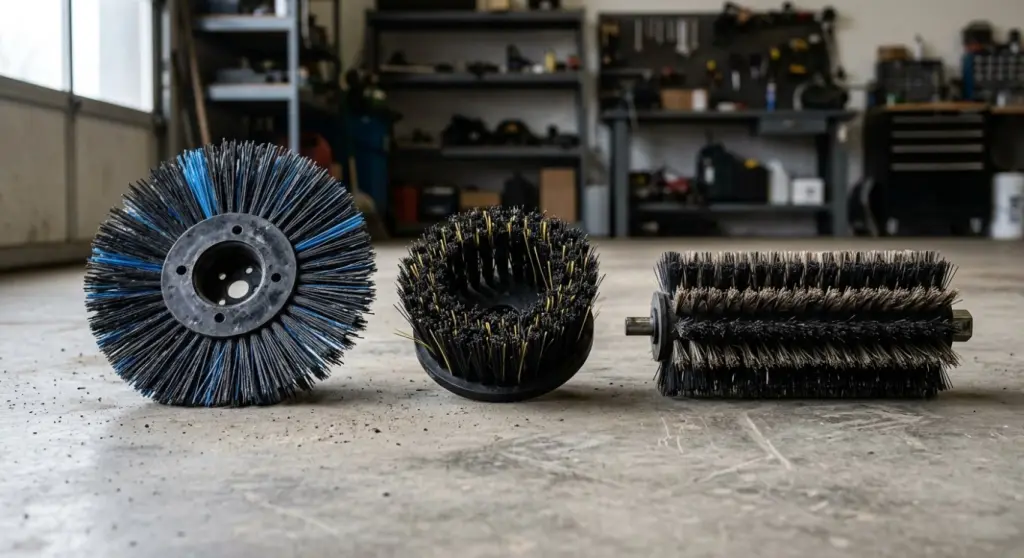
Bristle material decides whether your sweeper moves debris gently or scrapes it off the surface, and picking the wrong one either wears out the brush fast or leaves marks you didn’t want.
If you’re choosing between flexible and stiff for a specific site, think about what’s underneath the debris. Turf and pavement want poly. Gravel, ice, and construction grime want wire or a combination set.
The debris you’re clearing tells you almost everything about which broom and bristle combination to run, long before you think about brand or price.
A sweeper attachment is rarely the only tool you need on these jobs. Site prep and cleanup often go hand in hand, which is where other attachments, like a mini skid steer ripper or trench backfiller, come into play before or after the sweeping pass.
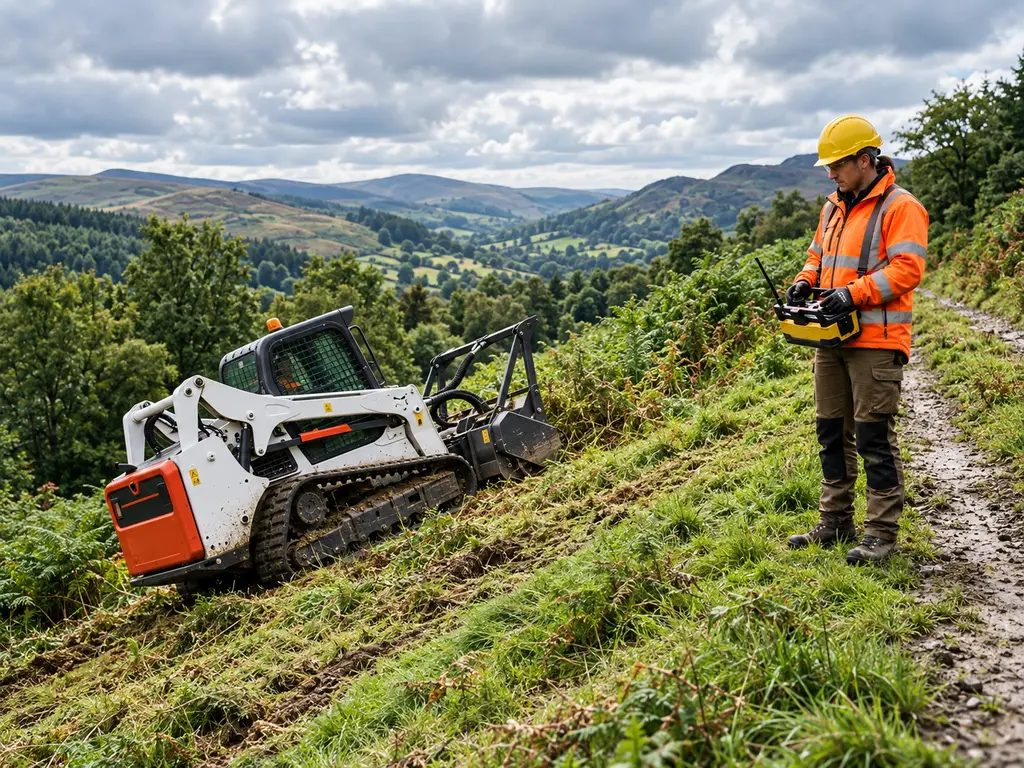
Sweeping debris off a slope or embankment with an operator seated on the machine becomes a stability risk the moment the brush catches resistance. The machine tips, the operator reacts late, and that’s how incidents happen on grades that look manageable from the ground.
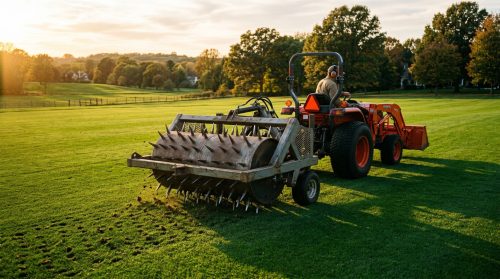
Remote operation changes that. It lets the operator stand clear and watch the brush contact point from a safer vantage, which matters most on uneven or sloped terrain where a seated operator’s view of the brush edge is limited.
Confined sites benefit too. Working between orchard rows or in tight property corners, a remote operator can reposition for visibility instead of guessing blind spots from inside a cab. That’s a real advantage when the sweeper is working close to trees, fences, or parked vehicles.
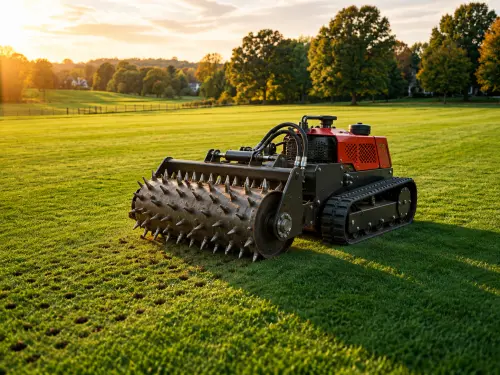
This is the same safety logic behind remote control track mowers on slopes, just applied to a sweeper attachment instead of a mower deck. Anqun Environmental Protection Technology Co., Ltd. specializes in remote control track mowers, compact mini skid steer loaders, and matching attachments built around that same positioning principle. If slope safety is a recurring concern on your sites, our article on slope mowing mistakes remote control mowers eliminate covers the underlying risks in more depth.
Before you order a sweeper, run through this checklist. Skipping any step here is the most common reason buyers end up with an attachment that doesn’t fit or doesn’t perform.
If you’re still deciding between carrier types before you get to attachments, our comparisons on track vs wheel skid steers and popular skid steer choices by use case are worth a read first.
Domestic rental listings won’t tell you anything about export compliance or OEM customization, but that’s exactly what matters if you’re sourcing equipment internationally.
Anqun supports OEM/ODM supply, stable production, and export-ready delivery for global partners, with machines designed to be CE-ready for export compliance. Configuration options extend beyond branding too, covering engine choice, protective features, and control setup. Anqun’s machines and spare parts already ship to customers in over 20 countries and regions, including Southeast Asia, the Middle East, and Europe.

Mismatched flow or weight causes more downtime than picking the ‘wrong’ broom type ever will. A pick-up broom used where an angle broom would’ve been faster just costs you a few extra passes. A sweeper that stalls your hydraulics or tips your loader arms costs you the afternoon.
Anqun offers attachment bundles as starter kits by use case for landscaping, farming, and property maintenance, which is a reasonable starting reference point if you’re not sure where to begin. Every unit goes through 100% functional testing before shipment, covering drive, hydraulics, controls, and safety checks, so what ships matches what was specified.
If you’re an international buyer putting together a custom-fit sweeper attachment, request the specs, manuals, and CE documentation before ordering. Check out Anqun’s product lineup or get in touch through the contact page to start that conversation.
It depends on the brush width and model, but the key is matching the attachment’s rated GPM range to your carrier’s auxiliary hydraulic output, not its engine size. Always check the attachment’s spec sheet against your machine’s hydraulic output before ordering, since undersized flow causes a brush to drag instead of sweep.
Usually not effectively. Full-size sweepers are built for higher hydraulic flow and often exceed a mini skid steer’s rated lift capacity, which can stall the brush or affect stability. Look for attachments specifically sized and rated for mini carriers instead.
Thicker wire bristles generally hold up longer against abrasive debris like gravel or caked mud, but they need more torque to spin, which pulls on your hydraulic flow. Poly bristles wear faster under abrasive conditions but are gentler on turf and paved surfaces.
 Guides
 Guides
 Guides
 Guides
 Guides
 Guides