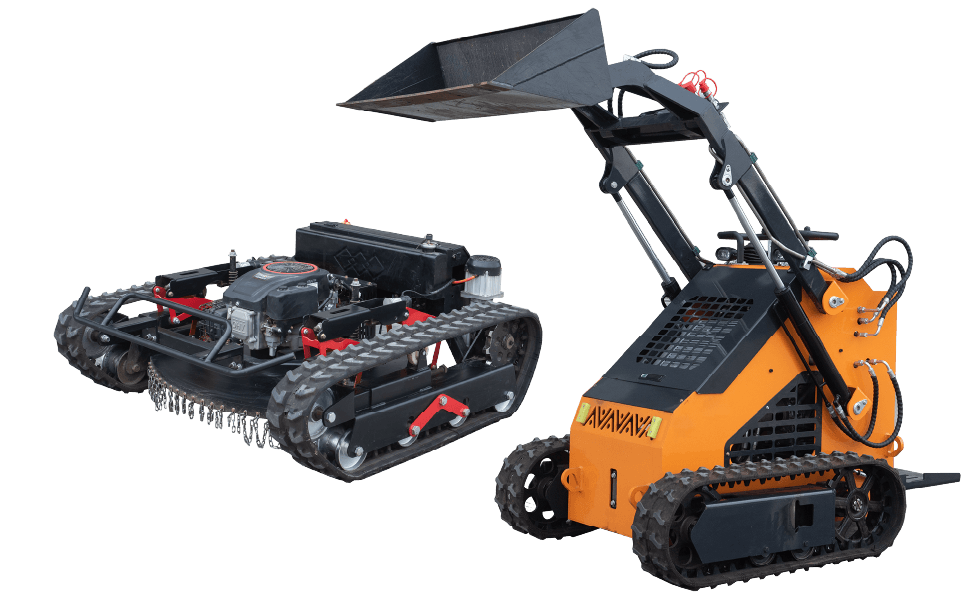
Track Mower & Skid Steer Loader Manufacturer

Contact Us
Track Mower & Skid Steer Loader Manufacturer
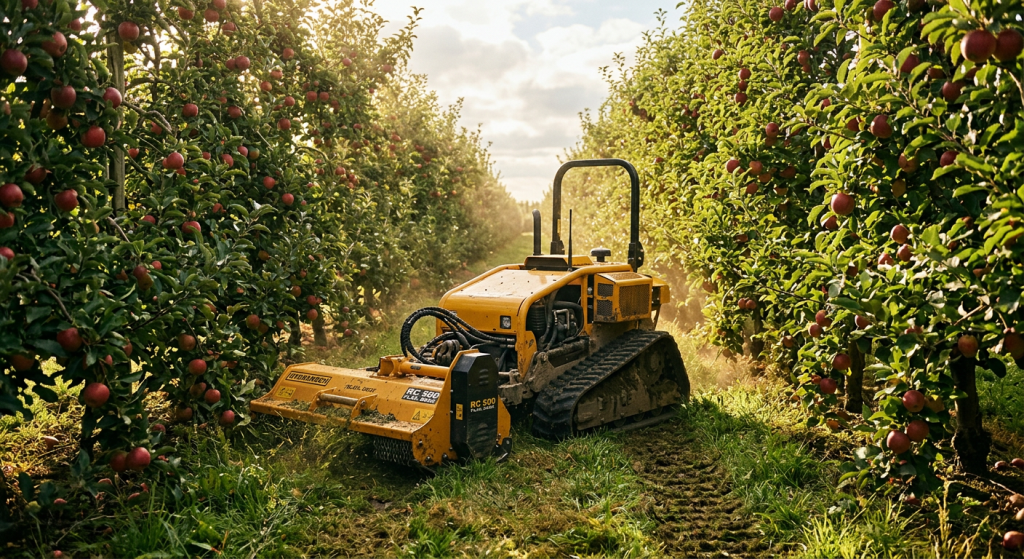
The fastest way to maintain ground cover between tight orchard rows is a compact remote-control track mower — typically 750–950 mm wide, with a flail or rotary deck, low ground pressure under 5 psi, and the ability to mow on slopes up to 55°. It threads between trunks where a ride-on can't fit, keeps the operator off the slope, and finishes a row in a fraction of the time a brushcutter takes. Below, we break down exactly how to use one effectively, where it pays off most, and what specs to look for.
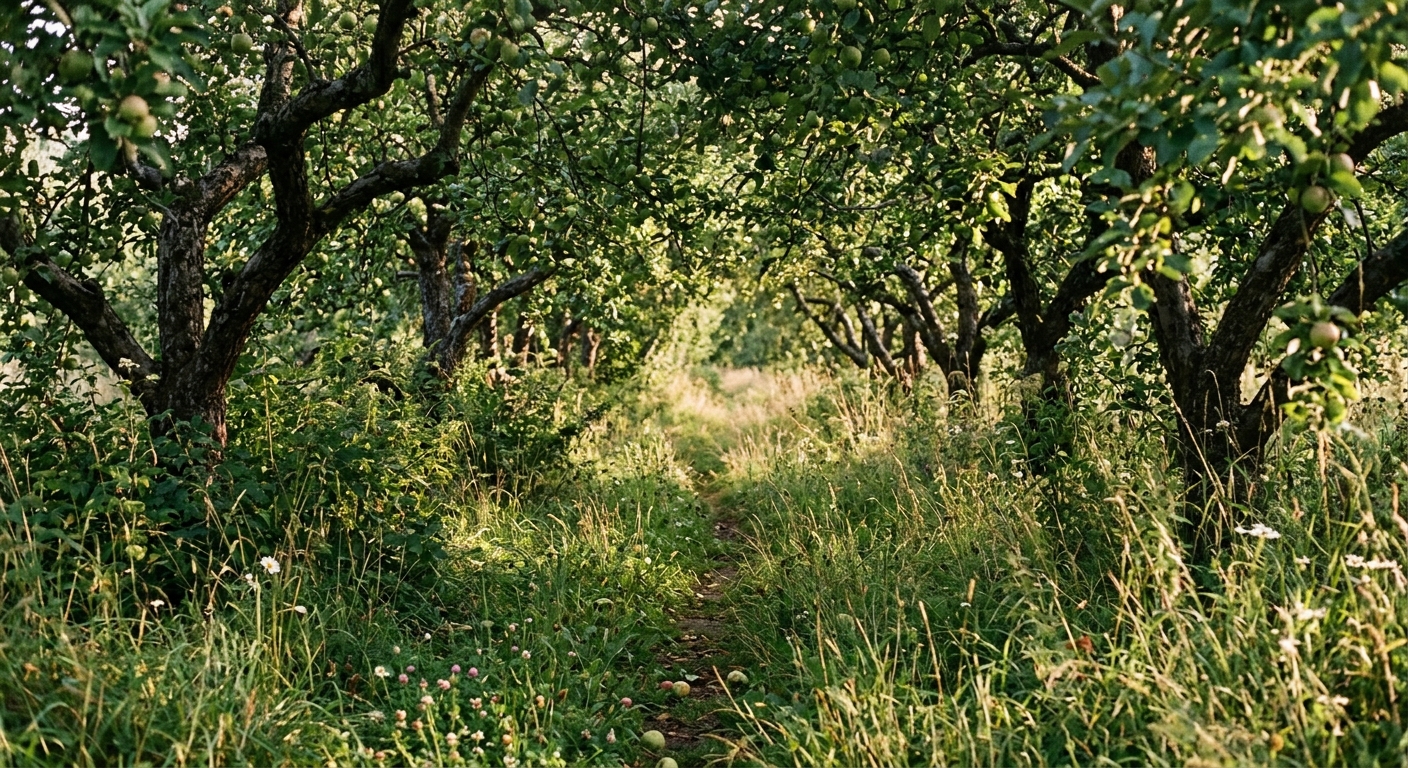
Apple, peach, citrus, and olive orchards are often planted on 2.5–3.5 m row spacing — and modern high-density blocks drop that to 1.8–2.2 m. A traditional ride-on mower with a 1.5 m deck leaves only centimeters of clearance on each side. One wrong steering input and you're scraping bark off a 10-year-old tree.
Add slope and the problem multiplies. Many orchards sit on hillsides for drainage and sun exposure. Once you exceed 15°, ride-on stability becomes a real safety issue, and operators start refusing the job — or worse, accepting it and getting hurt. Handheld brushcutters work, but a single hectare can take a full day per person.
A compact tracked mower sidesteps all three problems: width, slope, and labor. For orchard rows, farm lanes, and uneven ground, explore our compact track mowers for orchards.
Forget horsepower marketing for a minute. In an orchard, four numbers decide whether a machine earns its keep:
Engine power matters too, but a 20–25 hp diesel is plenty for a 750–900 mm flail deck. Anything more is weight you don't need.
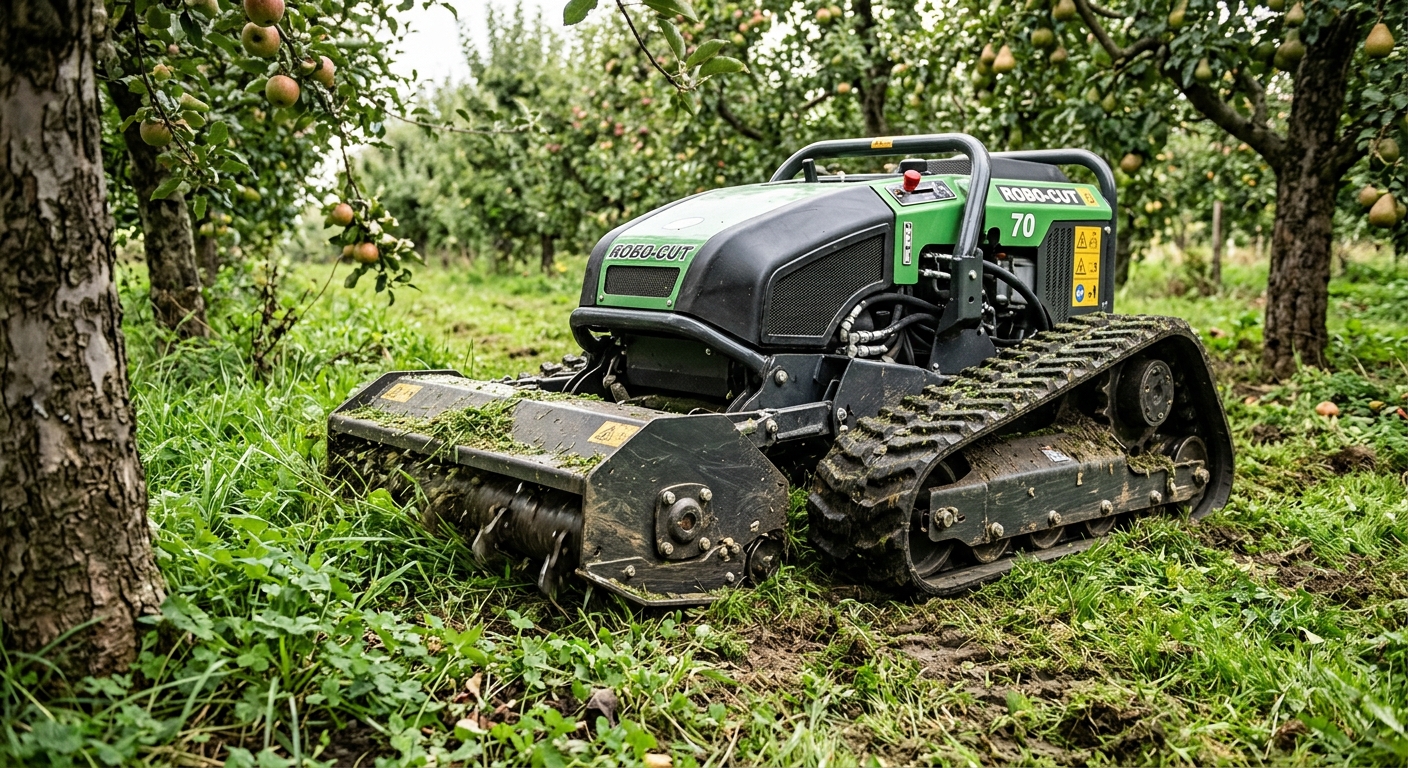
Here's the part most spec sheets undersell. A remote-control track mower lets one operator walk a comfortable 30–50 m behind the machine, watching trunks, irrigation lines, and low branches from a vantage point you simply don't get sitting on a ride-on.
That changes three things at once: the operator can mow steeper ground without risk, can spot problems (a broken sprinkler, a fallen branch) before the deck hits them, and can run the machine in heat or dust without fatigue. For a contractor managing 30 hectares of vineyard and stone fruit, that's the difference between finishing in three days and finishing in six.
For instance, a citrus grower in Spain we worked with used to run two operators on ride-on mowers, taking eight days to cover 25 hectares of lemon trees on 12° terraces. After switching to two remote track mowers, one operator handles the same area in five days — and bark damage claims dropped to zero.
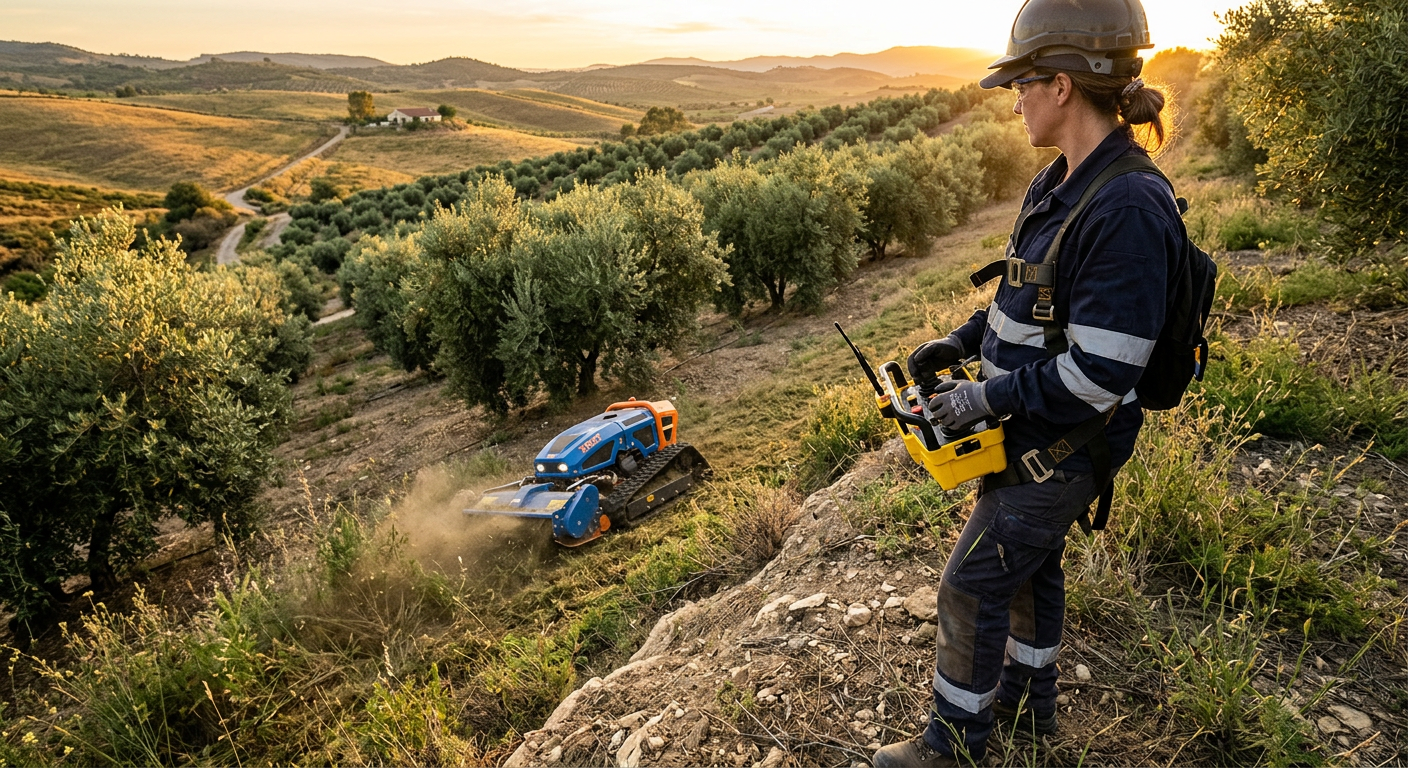
If you only mow grass and light weeds, a rotary deck is faster and cheaper. If you mulch prunings, brush, or knock down 60+ cm growth, a flail deck is non-negotiable. Most orchard owners need flail.
Flail hammers shred prunings into 2–5 cm pieces that decompose into the soil within a season, returning organic matter and reducing fungal disease pressure from rotting wood piles. Rotary decks throw long, stringy clippings that mat down, smother the cover crop, and clog irrigation emitters.
One caveat: flail decks are heavier and slightly narrower in cut width for the same chassis. If you're choosing between a 900 mm rotary and an 800 mm flail on the same machine, the flail is usually the right call for mixed orchard work.
Slope mowing kills operators every year. The OSHA and EU statistics aren't pleasant reading. Remote-control tracked mowers exist largely to fix this — and they do it well, but only if you respect the limits.
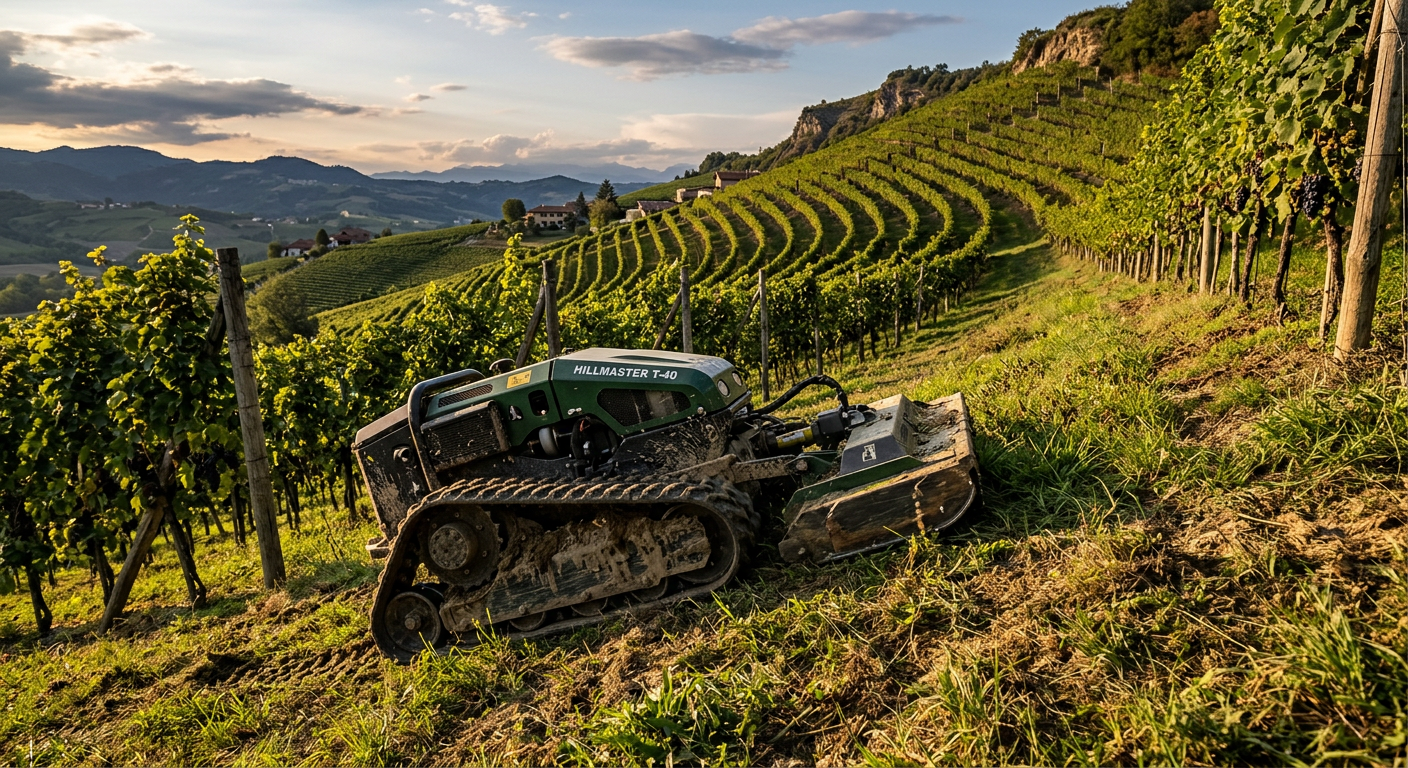
Most quality machines rate stable operation up to 45° and survival traverse up to 55°. In practice, plan your cutting pattern up-and-down the slope rather than across whenever possible. Track machines climb beautifully but can slide laterally on wet grass, especially with a heavy flail deck.
Keep these habits:
If you're weighing tracks against wheels for this kind of terrain, our breakdown of track vs wheel skid steer choice covers the same physics that applies to mowers.
The most expensive mistake in orchard mowing isn't slow work — it's damage. A single ringed trunk on a mature avocado tree represents 5–8 years of lost production. Three things prevent that:
Deck guards and side skirts. Rubber or polyurethane side deflectors absorb the inevitable brush against trunks without scarring bark. Steel-only decks are a false economy in orchards.
Camera or visual line-of-sight. Some operators add a small wireless camera to the machine for tight blocks, but most experienced contractors prefer walking position. You see depth and trunk distance better with your own eyes than through a screen.
Soft-touch turning at row ends. Counter-rotating tracks let you pivot in place — but doing so on bare soil tears it up and can damage shallow drip lines. Instead, use a gentle one-track-stopped turn on grassed headlands, and a wider arc on bare ground.
A peach grower in Georgia, USA, lost 14 trees in one season to ride-on bark damage before switching equipment. With a 1.1 m wide remote track mower, that number dropped to one in three years — and that one was a low branch incident, not a trunk strike.
Orchards are dusty, sappy, and full of woody debris — harder on mowers than open pasture. A track machine running 600–800 hours per year in orchard work needs:
Tracks themselves typically last 1,200–2,000 hours in orchard service — better than construction duty because there's less abrasion. Our practical guide on how long skid steer tracks last applies almost directly to compact mowers since they use the same rubber track technology.
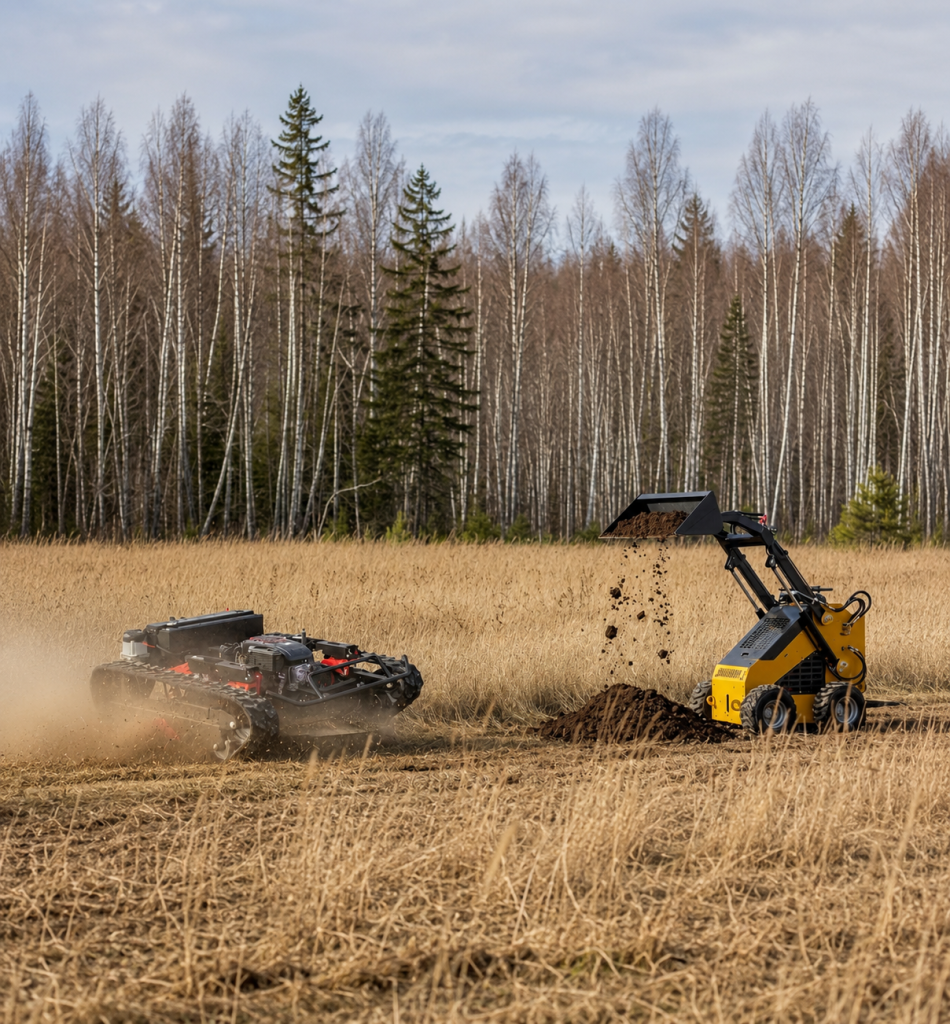
Honest take: a dedicated remote mower isn't always the right answer. If you also need to move bin pallets, dig irrigation trenches, spread compost, or load brush, a mini skid steer with a flail or brush-cutter attachment can do all four jobs from one chassis.
The trade-off: skid steers are wider (usually 900–1100 mm minimum) and the operator is on the machine, so slope and tight-row limits return. They shine in mixed-task orchards where mowing is one job among many.
If you're a multi-task operation, browse our full equipment range or look at most popular skid steer configurations by application. For pure mowing on slope or tight high-density blocks, the dedicated remote track mower wins. Our 2026 mini skid steer buying guide walks through the decision in more detail.
Good orchard mowing leaves a 5–8 cm uniform cover crop, no scalped patches, no bark damage, no compacted drip lines, and finished headlands with clean turns. If your current setup can't deliver that, the equipment is fighting you.
When evaluating a compact track mower for orchard work, check the spec sheet for: total width with deck, ground pressure, maximum stable slope (not just maximum survival slope), flail deck option, remote control range of at least 100 m, and a counter-rotating track system. Diesel is preferred over gasoline for the heat and hours involved.
Anqun builds remote-control track mowers and compact loaders specifically for this kind of work — narrow chassis, low ground pressure, flail or rotary deck options, and CE documentation for export buyers. If you'd like help spec'ing a machine for your row width, slope, and acreage, get in touch with our team and we'll match a configuration to your block.
 Guides
 Guides
 Guides
 Guides
 Guides
 Guides