Track Mower & Skid Steer Loader Manufacturer

Contact Us
Track Mower & Skid Steer Loader Manufacturer
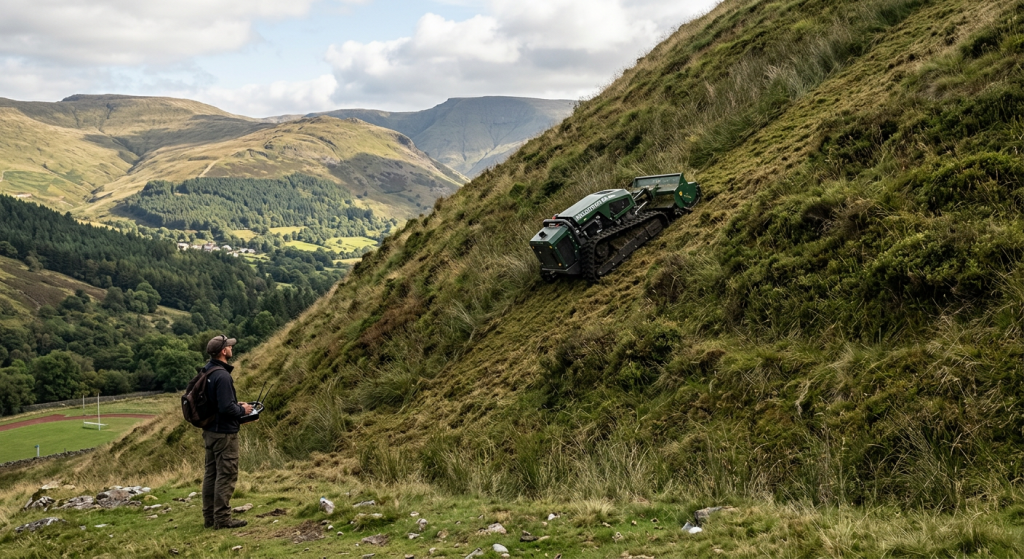
Most remote control track mowers are rated to handle slopes between 30° and 55°, with high-spec models capable of working on gradients exceeding 45° — terrain that would be genuinely dangerous for a walk-behind or ride-on mower. The exact limit depends on machine weight, track width, center of gravity, and ground conditions, so a single number never tells the whole story. This guide breaks down what those angle ratings actually mean in practice and what to look for when selecting a machine for serious slope work.
| Slope Angle | Gradient | Typical Use Case | RC Track Mower Suitability |
|---|---|---|---|
| 0°–15° | Up to 27% | Flat lawns, gentle embankments | Any mower — overkill for RC |
| 15°–30° | 27%–58% | Roadside verges, orchard rows | Excellent — standard RC track mower range |
| 30°–45° | 58%–100% | Steep embankments, dam faces | Purpose-built RC track mowers required |
| 45°–55° | 100%–143% | Extreme slopes, forestry terrain | High-spec RC mowers only — operator assessment needed |
| 55°+ | 143%+ | Near-vertical faces | Beyond rated capacity for most machines |
Slope angle is expressed in degrees or as a percentage gradient. A 45° slope equals a 100% gradient — meaning one meter of vertical rise for every meter of horizontal distance. Most manufacturers publish a maximum rated working angle, typically tested on dry, firm grass. That number is your ceiling under ideal conditions, not a guarantee across all terrain types.
For remote control track mowers, rated angles typically fall into three bands:
Exceeding the rated angle risks lateral sliding, loss of traction, or tip-over — which is precisely why remote operation exists. The operator stays on flat ground while the machine handles the hazard zone.
The rated angle is only achievable when several mechanical and environmental factors align. Understanding these helps you assess whether a machine will actually perform on your specific site.
Wider tracks distribute machine weight over a larger footprint, reducing ground pressure and improving lateral stability. A track mower with 400mm-wide rubber tracks will grip better on loose soil than one with 250mm tracks at the same angle.
Lower, heavier machines resist tipping. Machines with the engine mounted low and centrally — rather than high at the rear — maintain stability at steeper angles. This is why purpose-built slope mowers often have a compact, squat profile.
Wet grass, loose soil, or leaf litter can reduce effective traction by 10°–15° compared to dry, firm turf. A machine rated to 45° on dry ground may only be safe to 30°–35° after rainfall. Always factor in your worst-case conditions, not best-case.
Side-discharge decks and articulating cutting heads affect weight distribution. A front-mounted deck keeps weight forward, which helps on uphill traverses but can affect downhill stability.
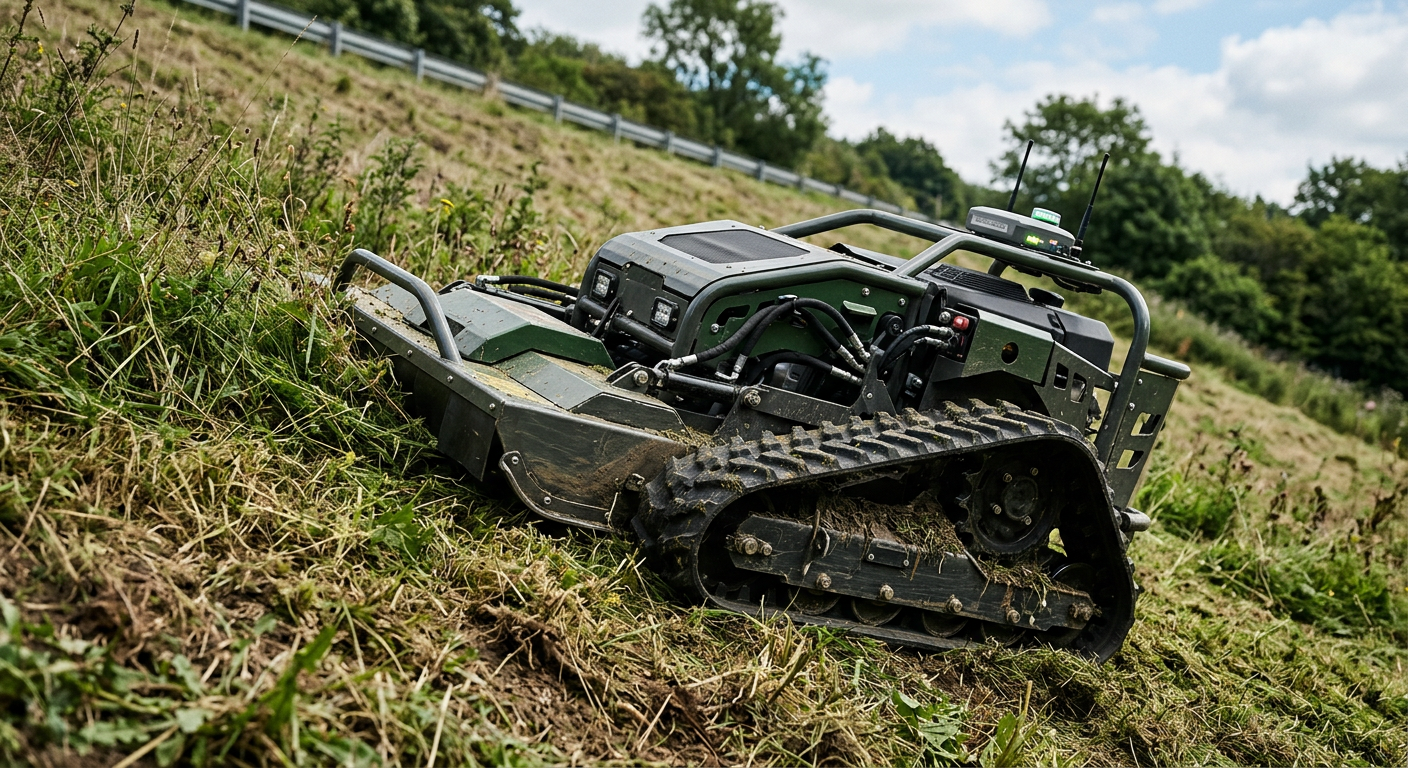
For hillside mowing, embankments, and uneven terrain, see our track mowers for slope mowing.
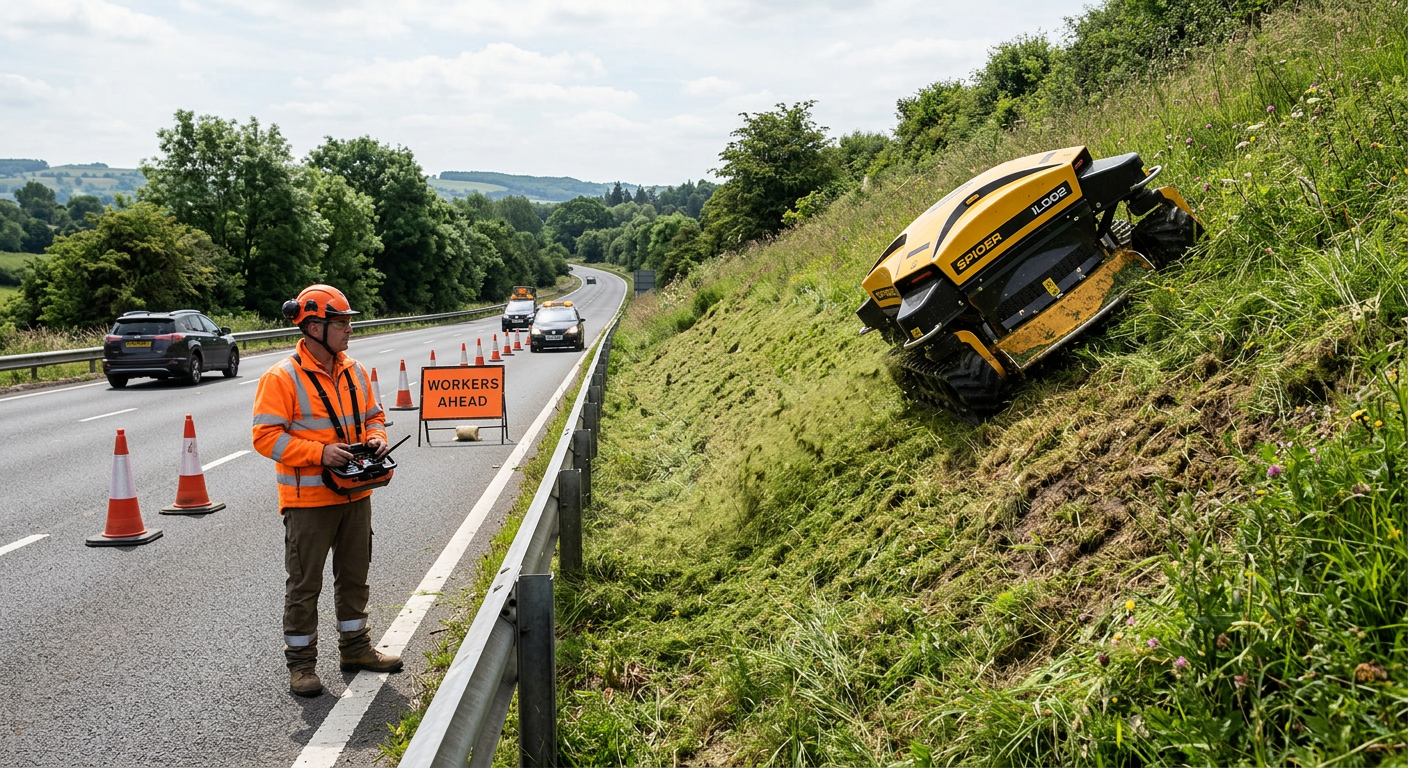
A practical illustration of where these specs matter: a highway maintenance contractor managing roadside verges along a rural route faced slopes consistently between 35° and 42°. Walk-behind brush cutters were slow, physically demanding, and posed rollover risk to operators on wet mornings. A ride-on tractor mower was ruled out entirely — the slopes exceeded its safe operating angle.
Switching to a remote control track mower rated to 45° resolved both the safety and productivity problem. The operator worked from the road shoulder, guiding the machine across the embankment face. Mowing time per kilometer of verge dropped by roughly 40% compared to the manual brush-cutting method, and zero personnel were exposed to the slope itself.
This scenario is common across landscaping applications and infrastructure maintenance — anywhere a consistent slope exceeds 30° and needs regular cutting throughout the growing season.
Angle alone doesn't capture the full picture. The geometry of the slope — how the machine traverses it — significantly affects safe operating limits.
Driving directly up or down a slope (climbing) is generally more stable than traversing across the face (side-hilling). Side-hilling shifts the machine's weight laterally and increases tip-over risk. Most manufacturers rate their machines for climbing; side-hill ratings are often 5°–10° lower.
A convex slope — one that curves outward at the top — creates a sudden change in gradient that can catch operators off guard. Concave slopes (bowl-shaped) are generally safer because the machine settles into the curve rather than cresting over it.
Stumps, rocks, or drainage channels on a slope force the machine to change direction mid-traverse, momentarily increasing lateral load. On slopes above 35°, clear terrain is a meaningful safety factor, not just a convenience.
For forestry and orchard environments where terrain is rarely clean, see how forestry applications approach slope mowing with remote control equipment.
Match the machine to your steepest regular working angle, then add a 5°–10° safety buffer. If your site peaks at 38°, specify a machine rated to at least 45°. Operating a machine at its absolute maximum rating on a routine basis accelerates wear and leaves no margin for variable conditions.
Key specifications to compare when evaluating models:
Anqun's remote control track mowers are engineered specifically for demanding slope environments, with models covering the full range from 30° verge maintenance through to 55° forestry and dam-face applications. If you're working across multiple terrain types, the broader track mower range includes configurations suited to orchards, embankments, and rough-cut forestry ground.
For buyers evaluating compact equipment across multiple use cases, it's also worth reviewing how agricultural and farming applications use slope mowers in orchard and vineyard settings — often the same machine serves both infrastructure and crop-row maintenance roles.
Ready to match a machine to your specific slope? Contact Anqun Machinery with your site angle, terrain type, and cutting width requirements — the team can recommend the right model and configuration for your conditions.
 Guides
 Guides
 Guides
 Guides
 Guides
 Guides