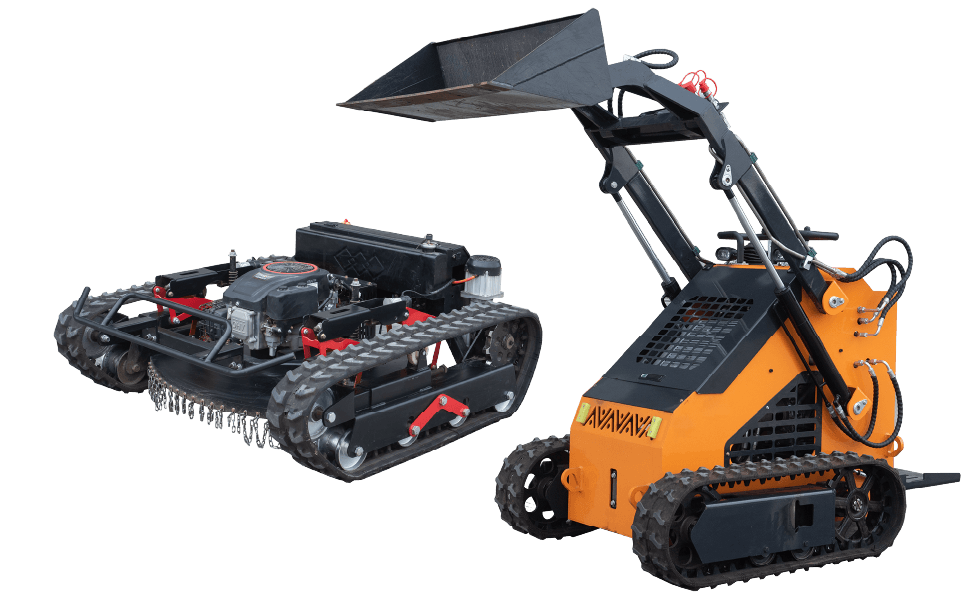
Track Mower & Skid Steer Loader Manufacturer

Contact Us
Track Mower & Skid Steer Loader Manufacturer

If your jobsite has narrow gates, sensitive turf, or tight rows between trees, a mini skid steer is often the better fit — and it runs the same utility attachments, like a skid steer trench backfiller, that larger machines use. But if you're moving heavy pallets, grading large lots, or digging foundations, a full-size skid steer has the muscle and lift capacity to get it done faster. The real decision isn't about which machine is 'better' — it's about matching horsepower and footprint to the actual job in front of you.
Here's a mistake we see constantly: buyers compare horsepower specs side by side and assume bigger always wins. Wrong approach. The real question is access. A standard skid steer is typically 60 to 72 inches wide. Most residential gates? 36 to 48 inches. Do the math and you'll see why a lot of landscaping crews are stuck renting equipment or hand-digging jobs they shouldn't have to.
A mini skid steer, by contrast, is engineered around a completely different constraint: fitting through spaces a full-size machine never will. Think narrow side yards, orchard rows spaced eight feet apart, or courtyards behind a building with no vehicle access at all. If your work happens in these environments, width — not power — is the spec that matters most.
Rated operating capacity (ROC) is where the gap becomes obvious. A mini skid steer typically handles 500 to 1,300 pounds. A standard skid steer starts around 1,750 pounds and climbs past 3,000 for heavy-duty models. That's not a small difference — it's the line between moving mulch and moving structural material.
For site prep, foundation excavation, or shifting pallets of block and rebar, a standard skid steer earns its keep. It cycles faster, carries more per pass, and pairs with heavier attachments like augers, grapples, and pallet forks rated for real load.
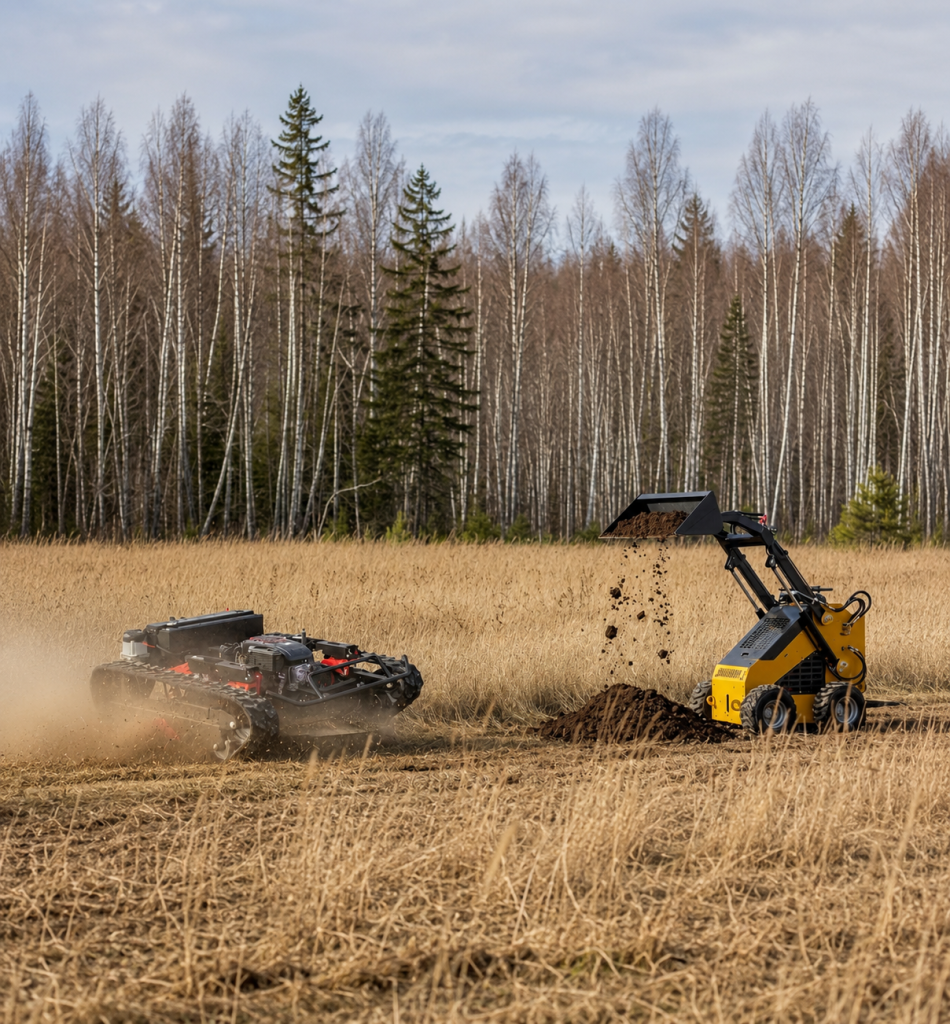
Most landscaping and orchard tasks — spreading soil, hauling debris, light grading — sit comfortably within a mini skid steer's capacity. Paying for 3,000 pounds of lift capacity you'll use twice a year is money better spent elsewhere.

Here's something spec sheets don't tell you: many mini skid steers now come with remote control operation, which removes the operator from the machine entirely. On a slope, near a retaining wall, or around unstable ground, that's not a convenience — it's a real safety upgrade. Standard skid steers keep the operator seated in the cab, which means every rollover risk, every visibility blind spot, is a direct threat to a person.
For instance, a landscaping crew clearing debris along a steep drainage ditch can stand at a safe distance and walk the mini skid steer through the slope rather than risking a tip-over with someone inside the cab. We cover this exact scenario in more detail in our piece on slope mowing mistakes remote control equipment eliminates — the same logic applies directly to loader work on grades.
Ground pressure is an underrated spec that costs contractors real money in callbacks. A full-size skid steer on rubber tires or wide tracks can rut wet turf, compact garden soil, or leave visible tire marks across a client's lawn. That's a repair job — or an angry phone call — waiting to happen.
Mini skid steers distribute weight over a smaller footprint but at lower overall load, which generally means gentler impact on turf and topsoil when properly matched to the job. For property management firms maintaining manicured grounds, that difference shows up directly in client satisfaction and re-seeding costs avoided.

Both machine classes run on quick-attach systems, but attachments are not interchangeable between size classes. A mini skid steer's hydraulic flow and mounting plate are sized for lighter-duty tools — grapples, small buckets, tillers, trenchers built for its weight class. Bolt a standard skid steer attachment onto a mini frame and you'll either overload the hydraulics or simply find it won't mount at all.
Buyers researching attachment options should check our guide on popular skid steer choices based on how they're used before committing to a machine — it breaks down which attachments pair naturally with which class.
Because mini skid steers spend more time on soft, uneven, or delicate ground, the tracks-versus-wheels decision carries extra weight. Tracked mini skid steers hold traction on wet slopes and distribute weight more evenly — critical for orchard rows or hillside landscaping. Wheeled versions move faster on hard surfaces like gravel or concrete pads but sacrifice some stability on grade.
We go deeper on this exact tradeoff in Track vs Wheel Skid Steer: Which One Fits Your Jobsite Best — worth a read before finalizing your undercarriage choice, especially if your job list mixes terrain types.
Consider a mid-size landscaping company handling 15 residential jobs a week, most with gated backyard access. Renting a standard skid steer runs roughly $300–$450 per day plus transport. Do that twice a week and you're looking at $2,400–$3,600 monthly in rental costs alone — before accounting for jobs you had to turn down because the machine couldn't fit through the gate.
Buying a mini skid steer outright at $18,000–$25,000 pays for itself within 8–12 months for a crew running that volume, while opening up every tight-access job competitors with full-size equipment can't touch. That's the real ROI conversation — not just sticker price.
Quick reference before you decide — match your job type against the specs below rather than defaulting to whichever machine your rental yard has on the lot.
| Criteria | Mini Skid Steer | Standard Skid Steer |
|---|---|---|
| Operating Width | 30–40 in | 60–72 in |
| Rated Operating Capacity | 500–1,300 lbs | 1,750–3,000+ lbs |
| Operator Setup | Remote control or stand-on | Enclosed cab, seated |
| Access Through Gates | Fits 36-inch gates | Needs wide access |
| Ground Pressure | Low, safe on turf | Higher, can rut soft ground |
| Purchase Cost | $15,000–$30,000 | $35,000–$80,000+ |
| Best Use Case | Landscaping, orchards, tight sites | Heavy construction, large earthmoving |
| Attachment Versatility | Good, lighter-duty attachments | Excellent, full attachment range |
If more than half your jobs involve gated properties, orchard rows, sloped terrain, or turf you need to protect, buy the mini skid steer — it's not even close. If you're primarily doing site development, large-scale material handling, or commercial construction, the standard skid steer's payload advantage justifies its size and cost. Some contractors end up running both, using the mini for finish work and access-restricted sites while the full-size machine handles bulk earthmoving.
Still unsure which capacity fits your fleet? Our guide on choosing the right mini skid steer loader for your business walks through sizing decisions in more detail, including how to match ROC to your typical attachment load.
 Guides
 Guides
 Guides
 Guides
 Guides
 Guides