Track Mower & Skid Steer Loader Manufacturer

Contact Us
Track Mower & Skid Steer Loader Manufacturer
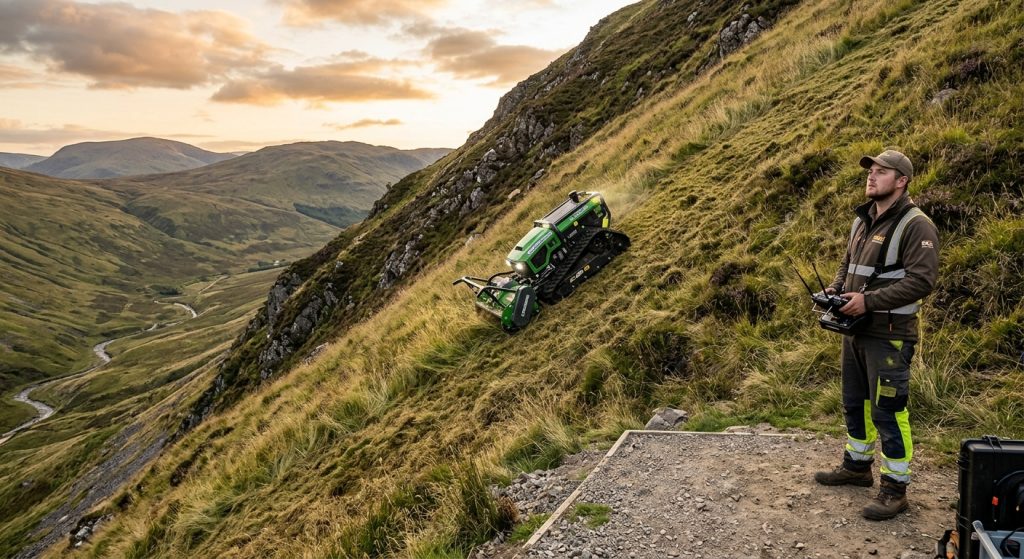
Remote control slope mowers eliminate five specific killers in one shot: rollover on steep grades, operator fall-from-machine, blade-strike injuries on hidden obstacles, heat exhaustion on long slope runs, and the “just one more pass” mentality that pushes ride-ons past their tipping point. Replace the seat with a transmitter and the geometry of the job changes overnight — low center of gravity, wide tracks, and an operator standing safely 30 meters away. The mistakes below aren’t theoretical. They’re the ones OSHA reports list year after year, and every single one disappears the moment you take the human off the chassis.
The textbook says “mow up and down on slopes over 15 degrees.” The crew foreman says “we don’t have all day.” Guess which one wins on a Friday afternoon?
Side-hill mowing is the single biggest cause of zero-turn rollovers. The center of gravity on a ride-on sits roughly 30–40 inches above the ground — once the uphill wheel loses traction or hits a depression, the machine tips before the operator can react. A 2,000 lb mower rolling at 7 mph downhill onto its operator is not a survivable event.
A remote control track mower flips this geometry. The center of gravity sits below 18 inches. The track footprint is 40–60% wider relative to height. And critically, when something does go wrong, the operator is standing on flat ground with the transmitter in hand. We’ve had landscaping contractors in the Pacific Northwest report cutting 45-degree highway embankments that their previous crew refused to touch with ride-ons.
For steep, uneven, or high-risk mowing areas, explore our remote control track mowers for steep terrain.
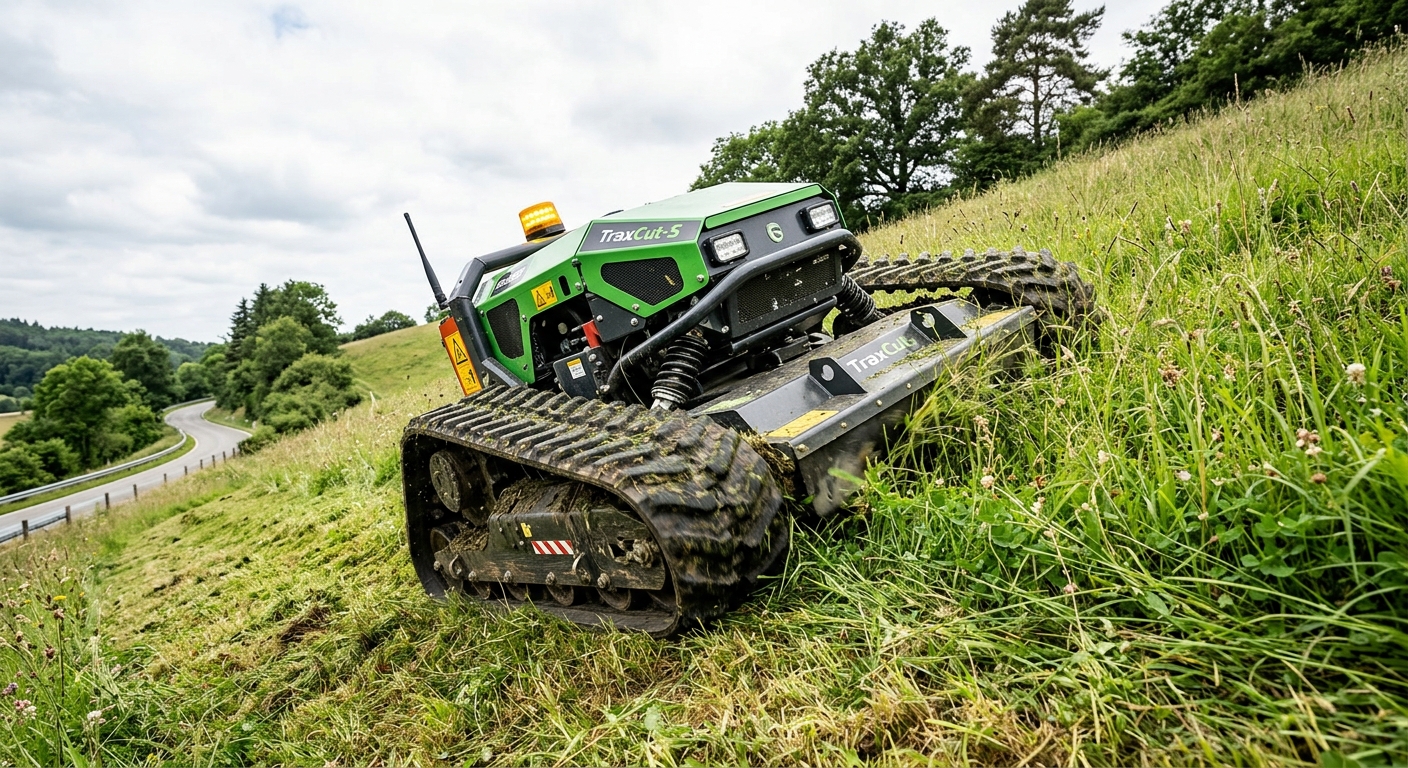
Wet grass on a 25-degree slope has roughly the friction coefficient of a bowling alley. Yet walk-behind crews do it constantly because the job’s due tomorrow and rain doesn’t care about schedules.
Two things happen. First, the operator slides — usually downhill, sometimes underneath the deck. Second, the mower slides, and the operator instinctively grabs the handlebar to stop it. That’s how feet end up near rotating blades.
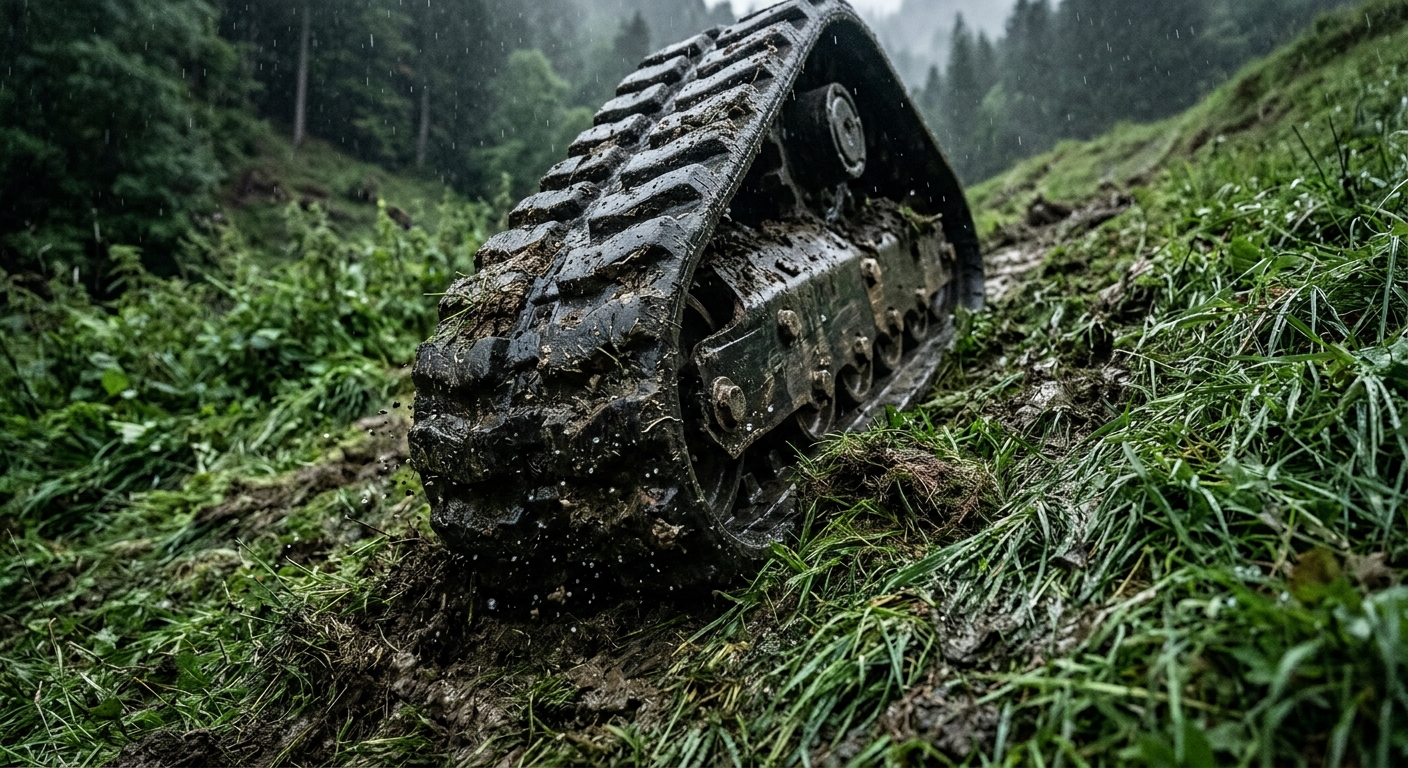
Rubber tracks distribute ground pressure to around 2.5–3.5 psi — less than a human footprint. Combined with aggressive cleats and hydrostatic drive that brakes both tracks independently, a remote mower holds position on wet slopes where a person literally cannot stand up. For property management firms maintaining retention ponds and detention basins, that’s the difference between mowing weekly and mowing “whenever it dries out” — which in some climates is never.
Roll-over protective structures only work if the seatbelt is buckled. Industry surveys consistently show 60–70% of ride-on operators don’t buckle up on slopes — because if the machine starts to go, instinct screams “jump.” And jumping puts you exactly where the mower lands.
This isn’t a training problem you can fix with another toolbox talk. It’s a human reflex. The only real solution is removing the operator from the equation. With a remote control mower, there’s no seatbelt debate, no jump-or-stay decision, no ROPS to inspect. The worst-case scenario is replacing a machine — not a person.
For example, a municipal grounds crew responsible for cemetery slopes switched to remote control after a near-miss where a ride-on slid sideways into a headstone. Six months later their workers’ comp modifier dropped a full bracket. The math wasn’t complicated.
Old fence posts. Half-buried concrete. Irrigation valve boxes. Drainage grates. Every overgrown slope hides something, and on a ride-on you find them with the deck — usually accompanied by a launched projectile or a snapped spindle.
The danger isn’t the broken blade. It’s the sudden stop. A ride-on hitting a buried obstacle at 6 mph on a slope can pivot violently, and the operator’s weight shift finishes the rollover the obstacle started.
Standing 20–30 meters away with a clear view, the operator sees terrain changes before the mower reaches them. They can stop, reverse, or steer around at the first sign of resistance — no inertia, no panic input. And if the deck does strike something, the worst outcome is a service call, not an ER visit. Forestry operators clearing roadside embankments find this especially valuable; the same logic applies in orchard rows where roots and irrigation lines hide under groundcover.
Eight hours strapped to a vibrating seat in 95°F sun, surrounded by engine heat and reflective grass glare — that’s a recipe for cognitive impairment that mimics being legally drunk. Studies on heavy equipment operators show reaction times degrade 20–30% by hour six in hot conditions.
Slow reaction times on flat lawns mean missed trim lines. Slow reaction times on a 30-degree slope mean a rollover that started two seconds earlier than the operator registered. Fatigue is the invisible cause behind incidents officially logged as “operator error.”
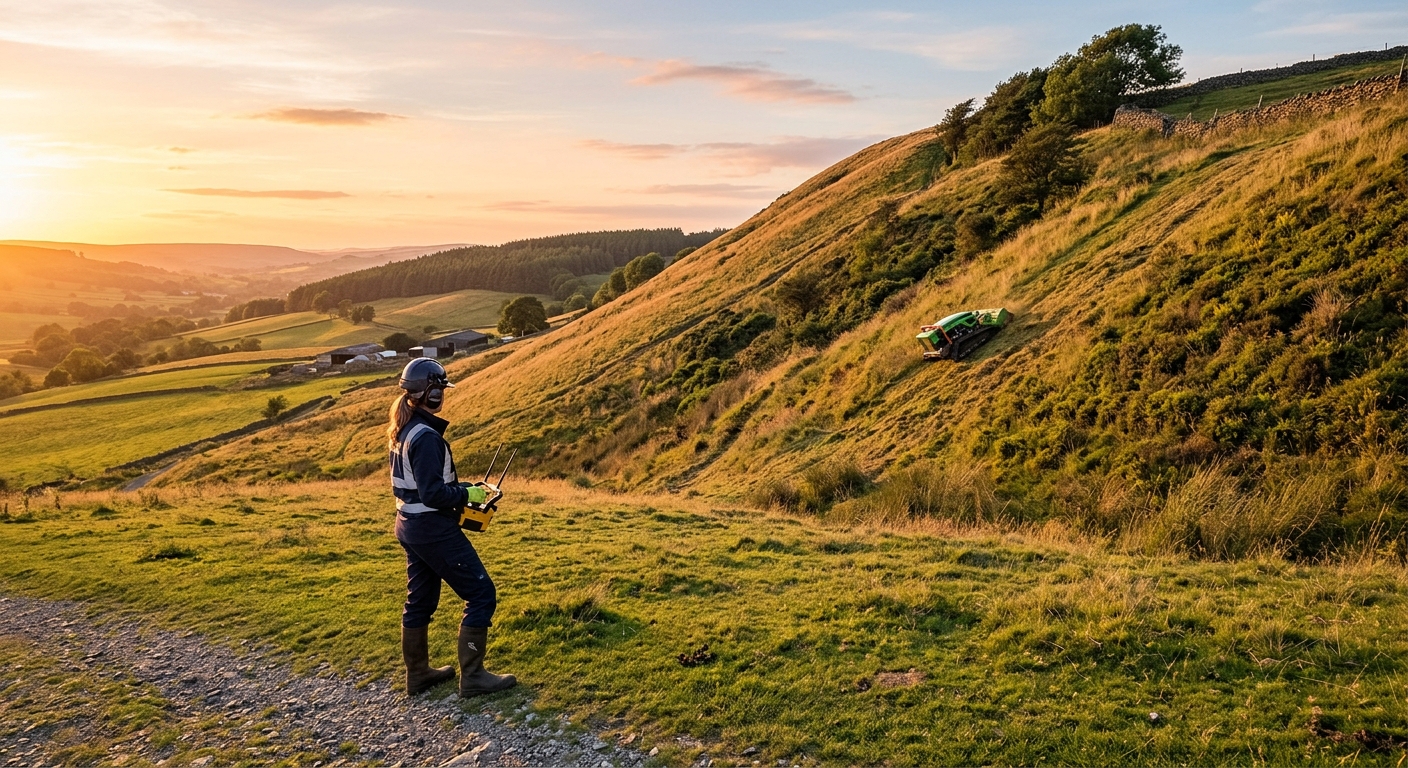
A remote control mower lets the operator stand in shade, drink water freely, rotate with a teammate every hour, and never absorb engine vibration. Productivity over an 8-hour shift goes up — not down — because the human stays sharp. One landscaping company we work with runs two remote mowers with a single operator who alternates between them, effectively doubling output while halving fatigue exposure.
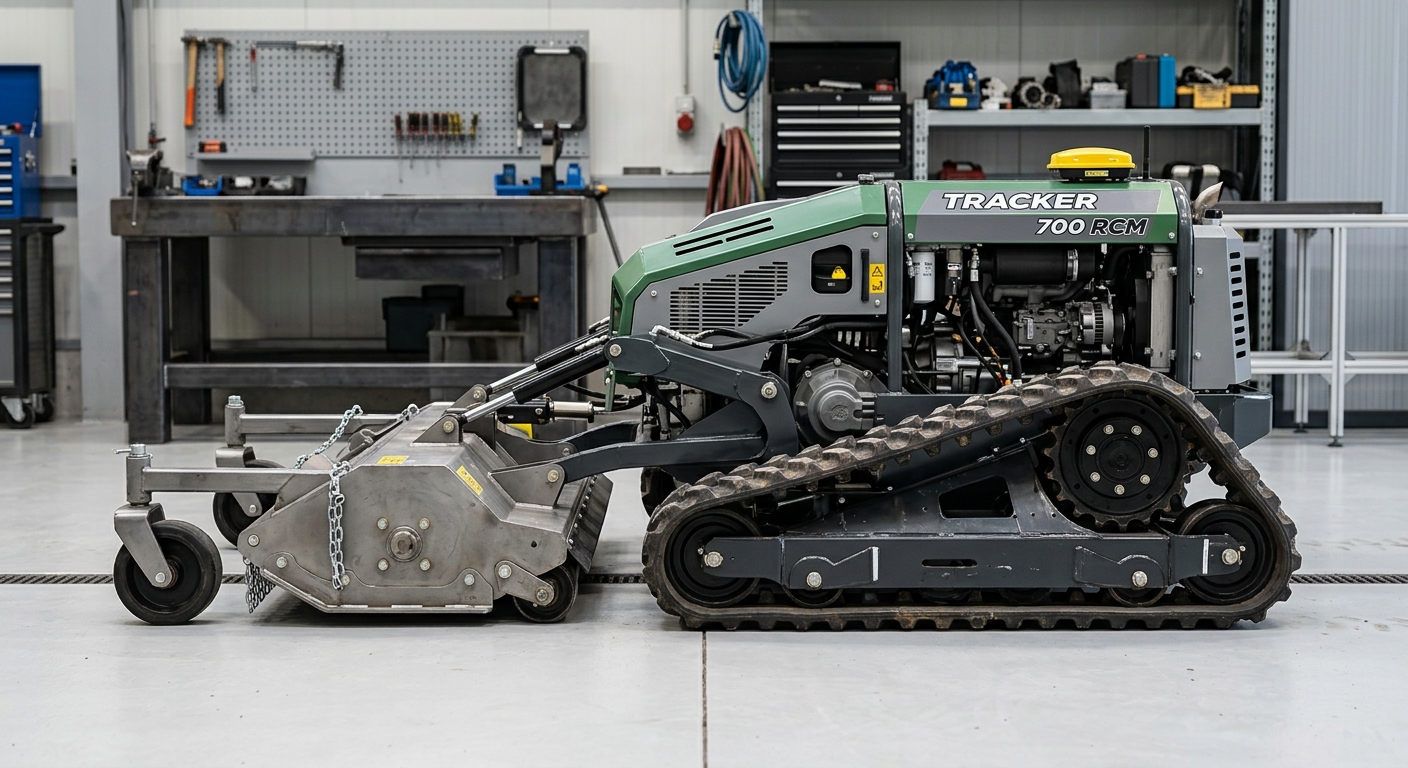
Marketing claims are cheap. Numbers aren’t. When you’re evaluating a remote slope mower, these are the specs that actually determine whether it survives real work:
If you’re comparing platforms more broadly, our guide on track vs wheel machines covers the same physics from a loader perspective — same principles, different attachments.
Buying the machine is step one. The bigger shift is how you bid and schedule work.
Slopes you previously refused — railroad embankments, retention ponds, solar farm perimeters, levees — are suddenly billable. Margins on these jobs tend to be 30–50% higher than flat-lawn work because so few competitors can do them safely.
Weather sensitivity drops dramatically. Wet mornings that used to kill productivity become normal working hours. A property management firm running three crews can effectively gain 1–2 working days per week in spring and fall.
Talk to your carrier before you buy. Many will reduce slope-mowing exclusions or premiums when you document remote operation procedures. The savings often offset 20–30% of the machine cost annually.
Honest take: remote control isn’t magic for every job. On flat 5-acre lawns you’ll cut faster with a 72-inch zero-turn — the remote mower’s 30–48 inch deck is built for terrain, not speed. Tight ornamental areas with delicate landscaping benefit more from a walk-behind operator who can finesse around plantings.
The sweet spot is anything steeper than 20 degrees, anywhere the ground is wet or unstable, and any job where the consequence of a rollover is measured in lives rather than dollars. If 40%+ of your work hits those criteria, the ROI math usually closes within 18–24 months. If you’re unsure, our team can walk through your job mix — see the full range on our products page or browse use-case scenarios under applications.
The five mistakes — side-hill mowing on ride-ons, walk-behinds on wet slopes, trusting ROPS over reflex, hidden-obstacle strikes, and fatigue-driven errors — share one root cause: the operator is physically attached to a machine doing dangerous work. Detach them, and the entire risk profile collapses. That’s the overnight change.
Whether you’re a landscaping contractor losing bids on steep work, a forestry operator clearing roadside corridors, or a municipal team responsible for dams and basins, the remote control track mower turns refused jobs into your highest-margin work. If you’d like spec sheets, slope-rating documentation, or OEM/ODM options for a specific deck width and engine package, get in touch with our team — we ship CE-documented machines worldwide and can usually match a configuration to your job mix within a week.
 Guides
 Guides
 Guides
 Guides
 Guides
 Guides