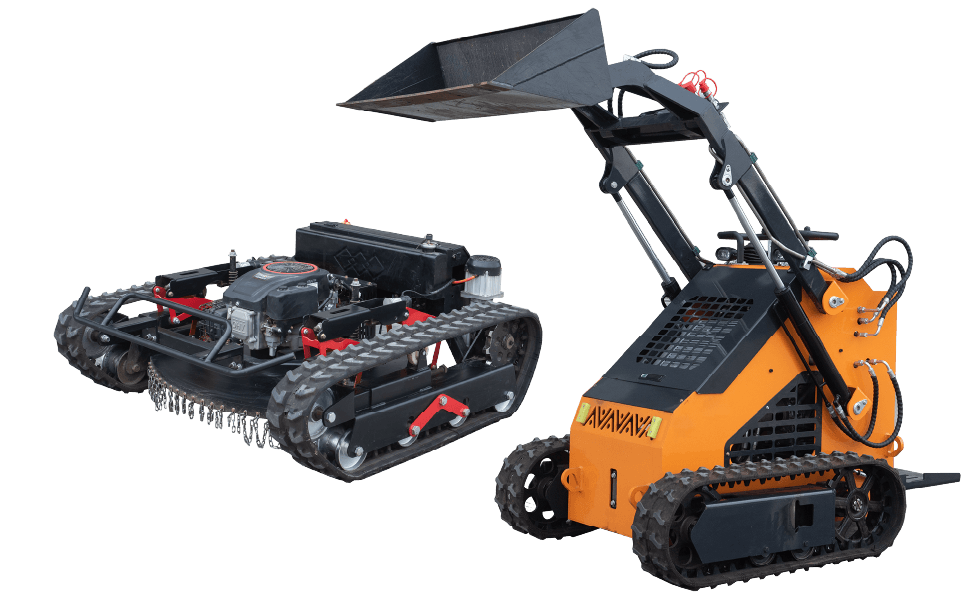
Track Mower & Skid Steer Loader Manufacturer

Contact Us
Track Mower & Skid Steer Loader Manufacturer

The right mini skid steer for landscaping work comes down to three things: matching machine width to your tightest access point, hydraulic flow, and the attachments you'll run — such as a sweeper broom attachment for paths and hardscape cleanup. Skip any of these three checks and you'll either be renting a bigger machine for the jobs your new loader can't reach, or replacing attachments you thought would fit.
Most buyers start by comparing horsepower and lift capacity. Wrong move. The first number that matters is your narrowest access point — a side gate, an alley between houses, a path between raised beds. Measure it before you shop.
A standard residential gate runs 36 to 42 inches. Mini skid steers built for landscaping typically range from 30 to 46 inches wide, so a few inches can decide whether you're driving through a gate or unloading a machine on the street and hand-carrying tools the rest of the way.
A landscaping crew in a suburban HOA community once rented a full-size skid steer for a backyard renovation job. It didn't fit through a single fence gate on the property. They ended up hand-digging a two-day job that a 34-inch mini skid steer would have finished in an afternoon. Measure twice, buy once.

For landscaping work on slopes, wet lawns, or freshly graded soil, tracked mini skid steers outperform wheeled ones almost every time. Tracks spread weight over a larger footprint, which means less turf damage and better traction on grades over 15 degrees.
Wheeled units are lighter, cheaper, and faster on hard surfaces like driveways or compacted gravel. But the moment you're on a slope with morning dew still on the grass, wheels lose grip fast. If your work regularly includes embankments, retention ponds, or orchard rows, tracks are the safer long-term investment. For a deeper breakdown of when each undercarriage makes sense, see our comparison on track vs wheel skid steers.

If your crew mows or grades anything steeper than a gentle backyard slope, remote-controlled operation earns its price premium fast. Standing beside the machine instead of riding it removes the single biggest injury risk in slope work — rollover.
Remote units also let one operator work terrain that would otherwise require two people: one to spot, one to drive. We've covered this in detail in 5 dangerous slope mowing mistakes remote control mowers eliminate, but the short version is simple — if a slope makes you nervous walking it, it's a bad slope to ride a machine on.

A mini skid steer is only as versatile as its attachment plate. Most manufacturers use a universal quick-attach standard, but mini and micro-class machines sometimes use proprietary mounts to save weight. Before buying, confirm the plate accepts standard buckets, augers, trenchers, and flail mowers — not just the two attachments bundled with the machine.
A property management firm handling both mowing contracts and seasonal planting jobs needs one machine that swaps between a mower deck and a auger in under five minutes. If the attachment system requires tools or adapters, that's lost billable time on every job. Browse the full range of compatible attachments and machines before finalizing a purchase decision.

Rated operating capacity (ROC) gets thrown around a lot, but for landscaping work, tipping load and lift height matter more day-to-day. A machine with a 1,000 lb tipping load might only offer a safe working capacity of 350 lbs at full extension — important when you're lifting root balls or pallets of pavers.
For most landscaping tasks — soil movement, mulch spreading, small tree relocation — a mini skid steer with 800–1,400 lbs ROC and a lift height of 6–7 feet covers the vast majority of jobs. Going bigger just adds weight and width you don't need for tight-access work.
Diesel mini skid steers dominate the commercial landscaping market because of torque under load and fuel efficiency over long shifts. Gas units are lighter and cheaper upfront but burn through fuel faster under heavy attachment loads. Electric and battery-hybrid mini skid steers are gaining ground for noise-sensitive residential jobs — think early-morning HOA work where diesel clatter draws complaints.
If your crew runs 6+ hour days on commercial contracts, diesel remains the better long-term value. If you're doing shorter residential visits in noise-restricted neighborhoods, a smaller gas or electric unit might actually save you scheduling headaches.
Tracks wear out. It's not a matter of if, but when — and knowing the expected lifespan before you buy helps you budget replacement costs into your pricing. Rubber tracks on a well-maintained mini skid steer typically last 1,200–1,800 hours depending on terrain abrasiveness and operating weight.
Rocky or highly abrasive soil cuts that lifespan down significantly. If you're buying for orchard or construction-adjacent landscaping work with rough terrain, check our detailed breakdown on how long skid steer tracks last so you're not surprised by the replacement bill.
If you're a landscaping company importing equipment, or an equipment dealer sourcing for international clients, CE documentation and OEM flexibility can make or break the deal. A supplier that offers in-house welding, machining, and testing means fewer quality inconsistencies across bulk orders — something that matters if you're outfitting a whole fleet, not just one machine.
Explore the full range of applications these machines serve across landscaping, agriculture, construction, and forestry to see how OEM-built mini skid steers scale from single-operator crews to fleet purchases.
 Guides
 Guides
 Guides
 Guides
 Guides
 Guides