Track Mower & Skid Steer Loader Manufacturer

Contact Us
Track Mower & Skid Steer Loader Manufacturer

A remote-control track mower keeps you safe on slopes in a way a zero-turn mower simply cannot: the operator stands off the machine entirely, so there's no rollover to survive. Zero-turn mowers are excellent on flat and gently rolling turf, but they were never engineered for the 20-45 degree grades that landscaping crews, orchard owners, and property managers deal with every week. If your job involves slopes, ditch banks, retention ponds, or highway embankments, the safety gap between these two machines isn't marginal — it's the difference between a walk-away incident and an ambulance call.
Here's a number that should worry every landscaping supervisor: most zero-turn mower manufacturers cap their recommended slope angle at 15 to 20 degrees — that's roughly a 3:1 grade. Push past that, and the physics turn against you fast.
A zero-turn's center of gravity sits high, right where the operator sits. Add a full fuel tank, a bagging attachment, or wet grass clippings clumping on one side of the deck, and the tipping point drops even further. Add rain-slicked turf and you've got a mower that can slide sideways before the operator even feels it happening.
Most zero-turn rollovers on slopes don't happen going straight up or down — they happen during a turn near the top or bottom of the grade, when the machine's weight shifts laterally. That's exactly the moment operators feel most confident, which is what makes it dangerous.

Remote-control track mowers don't reduce slope risk — they eliminate the human variable from it. The operator walks the perimeter with a handheld controller, often 10-30 meters away, while the machine does the climbing. If the mower loses traction or tips, there's no one on board to get hurt.
Wide steel or rubber tracks spread the machine's weight over a much larger contact area than a tire, which is why these mowers can handle 50-55 degree slopes that would be suicidal on a riding mower. Low center of gravity, hydrostatic drive on each track independently, and a wide wheelbase all work together to keep the machine planted even when the ground underneath is uneven or soft.
We cover the mechanics of this shift in more detail in 5 Dangerous Slope Mowing Mistakes That Remote Control Mowers Eliminate Overnight — worth a read if you've had a close call on a hillside before.

Take a property management firm responsible for a retention pond bank at roughly 35 degrees — a common feature in suburban developments. Mowing it with a zero-turn means an operator either skips it entirely (leaving overgrowth that violates municipal codes) or attempts it anyway, often with a rope-and-harness setup that's slow and still risky.
Switch to a remote-control track mower, and the same job gets done in under an hour with the operator standing safely at the top of the bank. No harness, no risk of the machine sliding into the water, no insurance headache. This is precisely the scenario where the cost difference between the two machines stops mattering — the liability savings alone justify the purchase.

Numbers settle arguments better than opinions. Here's how the two machines actually stack up when slope safety is the deciding factor.
| Criteria | Remote-Control Track Mower | Zero-Turn Mower |
|---|---|---|
| Operator position | Off the machine | Seated on deck |
| Safe slope angle | Up to 50-55° | 15-20° typical limit |
| Rollover risk to human | None | High on wet/uneven ground |
| Ground pressure | Low, wide track | Higher PSI on tires |
| Best terrain | Steep, wet, uneven | Flat to gently rolling |
| Speed on flat ground | Moderate | Fast |
| Upfront cost | Higher | Lower |
| Liability exposure | Lower | Higher on slopes |
Let's be fair — track mowers aren't the answer for every job. On large, flat athletic fields or open commercial lots, a zero-turn will out-mow a track machine on raw speed and cost per acre. If your terrain is consistently under 10 degrees, spending extra on a track mower doesn't buy you much beyond a smoother ride.
Zero-turns also win on parts availability and operator familiarity in North America — nearly every landscaping crew already knows how to run one, which shortens training time. The honest answer is that many operations need both machines: zero-turns for the flat acreage, track mowers for the slopes and edge cases nobody wants to touch.
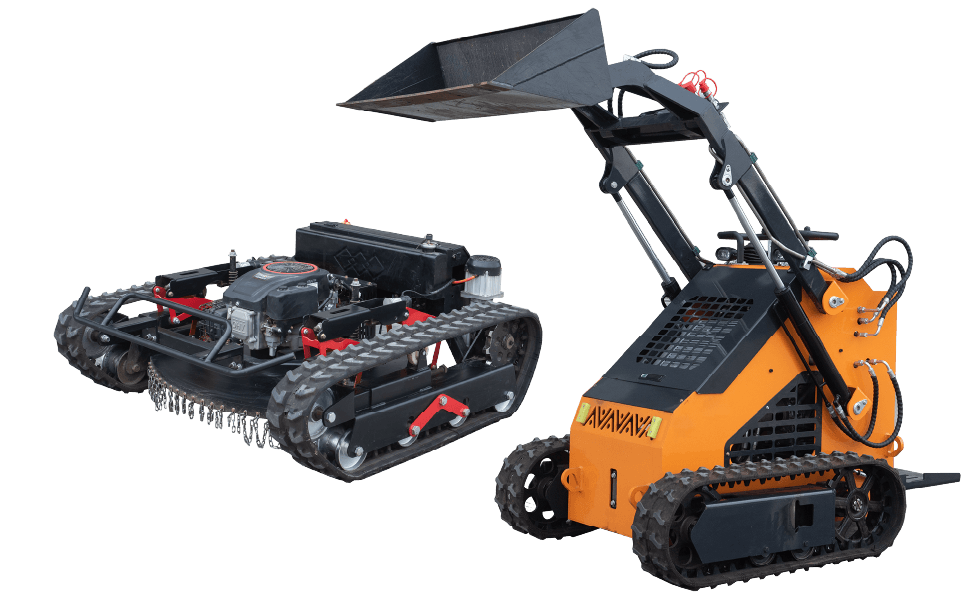
One thing buyers often miss: a quality remote-control track mower platform frequently accepts interchangeable cutting decks and attachments, similar to how mini skid steers do. That versatility narrows the price gap over time, because one chassis handles slope mowing, brush cutting, and light debris clearing instead of sitting idle between mowing seasons.
If you're already evaluating compact equipment for multiple applications, it's worth browsing our full product range to see how track mowers and mini skid steer loaders can share attachments and reduce the number of machines you need to own.

Rubber tracks aren't maintenance-free, and buyers who skip this research often get surprised by replacement costs down the line. Track wear depends heavily on terrain — rocky or abrasive ground chews through tracks faster than soft turf.
Before committing to a track mower fleet, it's worth understanding realistic service life. Our guide on how long skid steer tracks last applies the same principles to mower undercarriages — rotation habits, terrain matching, and proper tensioning all extend track life significantly.
If any part of your job involves slopes over 20 degrees, wet embankments, or terrain where a fall means real injury, a remote-control track mower isn't a luxury — it's the only machine actually built for that ground. Orchard owners managing sloped tree rows, highway maintenance contractors, and property managers with retention ponds all fall into this category. We've explored similar terrain challenges in Orchard Maintenance Made Simple: Using Compact Track Mowers Between Tight Tree Rows, which shows how the same stability advantage applies beyond pure slope work.
For flat commercial turf with no slope exposure, a zero-turn remains the faster, cheaper tool. Match the machine to the terrain, not the other way around.
 Guides
 Guides
 Guides
 Guides
 Guides
 Guides